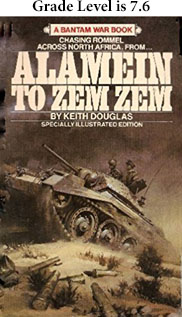
Alamein to Zem Zem by Keith Douglas

The epub format below is for your Apple and Android devices including the Send-to-Kindle feature in Amazon.

Download  the mobi file for Amazon devices except the Send to Kindle feature  here.

The reading level is 7.6 on the Flesch-Kincaid readability test. This book is in the public domain due to the author’s death in 1944 in Normandy. Copyright in the U.K. lasts for 70 years after the author’s death.


Reviews from Goodreads (4.18 rating with 620 ratings and 36 reviews):

One of the most vivid books of WW2 reportage ever written. It reads as quirky and unvarnished as ever and captures the brutality and sheer oddness of tank warfare.


An excellent book. What distinguishes it from the very many desert war memoirs is the details of daily life. This is because the book was built-up from very detailed diary entries, so that the excitement of looting some decent coffee, for example, or the author’s irritation at getting his prized uniform damaged beyond repair by the regimental doctor (to save his life!) are recorded in a detail rarely seen in more sweeping memoirs. This makes it a fascinating read in which one comes closer to understanding the actual life of a desert rat than in any other book I’ve read…


A marvelous read , full of humour and humanity. It has the ring of truth full of characters well described. He does not hide from the sheer awfulness of war but the anecdotes and lively description of his situation raise this memoir above the ordinary. Can recommend.


No preliminary b.s. in this book. By page 3 the author has gone A.W.O.L. from his desk job and headed into the North African desert to fight in Crusader tanks. This is small book but is full of terrible fighting, down time and the constant search for food, water and loot. It shows all the confusion of combat and how horrendous some of the injuries can be.


The author survived North Africa only to be killed on his third day in Normandy.


With this gripping and moving memoir Keith Douglas made a truly valuable contribution to the literary canon of the Second World War. Douglas drops us into his story with minimal introduction or context and ends with a trivial and tasteless comment about going out to gather loot. What happens to Keith and his unit, the Sherwood Rangers Yeomanry, after they leave Zem Zem is left unexplained. This is a book written very much in the moment, and Douglas’ observations and comments on his comrades, the enemy, his surroundings, and the war in general, have an immediacy that would likely be lost in a work written more analytically or at greater distance.


His wry observations are often both memorable, amusing and affecting: “it is exciting and amazing to see thousands of men, very few of whom have much idea why they are fighting, all enduring hardships, living in an unnatural, dangerous, but not wholly terrible world, having to kill and to be killed, and yet at intervals moved by a feeling of comradeship with the men who kill them and whom they kill, because they are enduring and experiencing the same things. It is tremendously illogical – to read about it cannot convey the impression of having walked through the looking-glass which touches a man entering a battle.” Douglas recognizes the irony and dark humour in the war and this suffuses his writing throughout the book, both in how he records his experiences and in his reflections on them.

Again he has the poets eye for beauty and emotional resonance, such as in this poignant passage: “Sometimes the surface of the desert where we halted for a few hours or a few days was thick with flowers which changed the ridges and hollows whose sandy colour had for weeks been relieved only by stones, the hiding places of scorpions – or the dead grey spouts of camelthorn – into undulating distances of blue-green. The sweet scent of the flowers would come up to your nostrils even in a tank turret, moving along; it could overcome all the odours of machines.” It’s not quite England’s green and pleasant land, and the war overshadows everything, but Douglas can readily tap into his own and his readers feelings, and not merely record the external details of his experiences. That same ability is apparent both in more pastoral passages such as the above, and in his more breathless memories of being under fire.

I’m glad I read this, and anyone with an interest in the Second World War will likely enjoy it. I’ll leave the last word of wisdom to Keith Douglas himself, in what is a fine proverb and rule for life:

“Books and flowers are invincible beautifiers. I have often used them to make horrible surroundings habitable.”

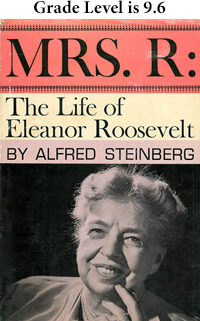
Cover with Photograph of Eleanor Roosevelt

Mrs. R: The Story of Eleanor Roosevelt by Alfred Steinberg

Download in epub format for Android and Apple devices:

Download in mobi format for Amazon devices:


“Mrs. R.” is a clear objective year-by-year account of the life of one of the world’s most famous women. Enjoy a biography by a writer who knew Eleanor Roosevelt and was able to interview her contemporaries.

The writer Alfred Steinberg is well known for his biographies of Harry S. Truman, Lyndon B. Johnson, Eleanor Roosevelt and Sam Rayburn. He also wrote more than 200 magazine articles, as well as book reviews and features for the Washington Post, the New York Times, Reader’s Digest, the Saturday Evening Post, Harper’s, Collier’s, and American Heritage.

Mr. Steinberg’s books included “Mrs. R,” this biography of Eleanor Roosevelt, whom he had known when she was United States Representative to the United Nations; “The Man From Missouri,” a biography of Truman, and “Sam Johnson’s Boy,” about Lyndon Johnson.

This was the first full-length biography of Eleanor Roosevelt, based upon her personal papers, when published in 1958. Previously known only through her own three-volume autobiography, Mrs. Roosevelt had remained something of a mystery and a legend, beloved by millions and disliked by some.

Over 4,000 of her personal letters and other private papers at the Hyde Park memorial library were studied by the author. He has woven all known sources of information into an extremely lively story, with the warmth and mastery of a fine novelist.

Here is the lonely childhood, disrupted by the death of loved ones, the shy emergence into wealthy society, the court-ship by Franklin under the possessive authority of his mother, the day-to-day events of Campobello and polio, the young wife’s reluctant participation in politics as the “eyes, ears and legs” of the man of destiny.

The reader will also see how the programs of the New Deal developed during the Depression, and how the Roosevelts worked together to repeal the Neutrality Acts in order to aid Great Britain at the start of World War II.

Eleanor Roosevelt became one of the world’s great travelers in her search for pertinent information concerning the state of all nations. Always the champion of the underdog, she gradually evolved into a figure alone and apart. Neither her husband’s death nor her own advancing age cut down the influence of this notable woman upon notable events.

An Excerpt from a Review by Arthur Schlesinger, Jr., The New York Times, October 12, 1958.

First Lady of the World
Mrs. R.: The Story of Eleanor Roosevelt. By Alfred Steinberg. New York: G.P. Putnam’s Sons.

Mr. Steinberg has gone through the Roosevelt literature and talked with many survivors of the Roosevelt era. He was also, he states, permitted to examine “the personal papers, record books and voluminous correspondence of Mrs. Roosevelt.” (Unfortunately “Mrs. R.” contains no footnotes, and one cannot usually distinguish between what is quoted from a document and what has popped up in someone’s recollection.) He begins with the troubled childhood, describes the reluctant emergence of the shy and awkward girl and follows through the transformation into the capable but somewhat gushing matron and finally into the incomparable First Lady of the World.The story is told briskly and sympathetically but not. altogether uncritically; on such matters as the Roosevelts as parents, Mr. Steinberg writes with candor. The result is a piece of intelligent and readable, journalism. …

…I think,too, that Mrs Roosevelt who emerges from this book as a somewhat blander character than she really is. Mr, Steinberg quotes from one of her letters to President Truman. “There are two things which I wish to avoid above all else,” Mrs, Roosevelt wrote, “one, war; two, a Republican victory.” These two wishes express succinctly the different aspects of Mrs. Roosevelt’s personality: on the one hand, the luminous idealist, yearning for the good, the true and the beautiful; on the other, the old pro, filled with canny and salty realism. Mr. Steinberg does more Justice to the first than to the second.