
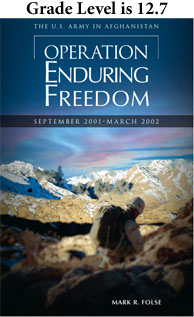
Cover with title of Operation Enduring Freedom

Operation Enduring Freedom, U.S. Army in Afghanistan: September 2001-March 2002 by Mark R. Folse

The epub format below is for your Apple and Android devices including the Send-to-Kindle feature in Amazon.

Download  the mobi file for Amazon devices except the Send to Kindle feature  here.

Mark R. Folse, a historian now teaching at the Naval Academy, provides an interesting overview of the first years of the US and Allied actions in Afghanistan. Mark Folse is also a U.S. Marine infantry veteran (2002 – 2006) with service in both Afghanistan and Iraq.

He explains why the US had to intervene and describes the successes and disappointments of the first months as the US ousted the Taliban from Kabul, but failed to find and kill Osama bin Laden at Tora Bora.

While Folse does not go on to explain how the mission crept from evicting al-Qaeda from Afghanistan to nation-building in Afghanistan, he does show how, in the early months, the only goal was the defeat of al-Qaeda. He also mentioned that Donald Rumsfeld, the Secretary of Defense at the time, rejected any negotiations with the Taliban. Obviously, the anger of Americans about the tragedies of 9/11 might have made early negotiations unlikely, but it is an interesting what-if. Why did Donald Trump later have the political space to invite the Taliban to Camp David for negotiations, you might ask your students.

And Folse provides background about the people of Afghanistan.  He writes of the religious zeal of the Taliban, which helped them in “recruiting and fighting” in the years they controlled Afghanistan after the Soviet withdrawal. Folse also shows how the terrain of Afghanistan made US operations difficult in many areas. Landing and resupplying troops on the sides of mountains was dangerous and made control of the countryside hard to achieve, Folse writes.

The Council on Foreign Relations has a useful timeline which your students might enjoy before reading Folse’s book. It is at https://www.cfr.org/timeline/us-war-afghanistan.
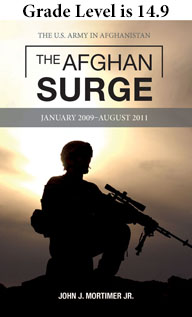
cover of The Surge

The Afghan Surge: The U.S. Army in Afghanistan by John J. Mortimer

The epub format below is for your Apple and Android devices including the Send-to-Kindle feature in Amazon.

Download in the epub format for Android and Apple devices:

Download in the mobi format for Amazon devices:

JANUARY 2009–AUGUST 2011
“The war in Iraq had long overshadowed the ongoing conflict in Afghanistan, receiving priority for resources and forcing the U.S. Army to make do with less for the latter mission. When the situation had worsened in Iraq in 2006, President George W. Bush opted for a dramatic and controversial change in course, committing additional troops and refocusing operations to protect the population centers. In December 2007, Chairman of the Joint Chiefs of Staff Admiral Michael G. Mullen summed up that reality, telling members of the House Armed Services Committee, “In Afghanistan, we do what we can. In Iraq, we do what we must.” By the time this new strategy, known as the surge, reached its culmination in mid-2008, it had drastically reduced the level of violence and brought a measure of stability to Iraq.

“American commanders deemed it a triumph and viewed it as a recipe that also could turn around the situation in Afghanistan. In October 2008, Bush authorized sending six thousand additional personnel as a down payment to bolster the failing effort in that theater. In early 2009, his successor, President Barack H. Obama, gave precedence to the mission in Afghanistan and authorized more troops. Lacking the fanfare of the Iraqi reinforcement, the effort in Afghanistan became the “quiet surge,” but it remained to be seen whether it would achieve similar results.”

This is the story of the surge in Afghanistan. The reading level is 14.9. If the weaker readers in your classes find the vocabulary difficult, you might suggest that they use Text to Speech services in the book to read the story to them. On iPads they can use Speak, Screen. On Android tablets they can install an app such as Aquile Reader and can select the voice which would be reading the text to them.