
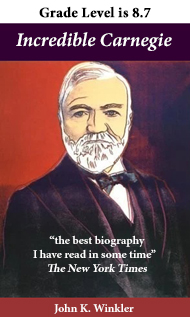
Incredible Carnegie by John K. Winkler
The epub format below is for your Apple and Android devices and new Kindles using the Send-to-Kindle feature in Amazon.
Download the mobi file for older Amazon devices here.
An excerpt from a review in The New York Times:
HEARST: A MODERN MONTE CRISTO; Mr. Winkler’s Biography Tells the Story of His Curious Career, By Charles Willis Thompson, The New York Times, May 27, 1928, p. 55 and p. 63.
IN 1898, when young W. R. (not then William Randolph) Hearst was blithely driving America into war with Spain, E. L. Godkin said in horror: ‘A black- guard boy with several millions of dollars at his disposal has more influence on the use & great nation may make of its credit, of its army and navy, of its name and traditions, than all the statesmen in the country…
…About a generation ago, we learn from John K. Winkler-who, it is well to say now and have done with it, has written the best biography I have read in some time-Hearst decided to make and own a political party. “The officers to be his employes: the workers to be in his pay the committees to be of his selection, and his word to decide policies and platforms.” Using the votes of this proprietary party as a club, he would dictate policies and candidates to the old parties, and would himself force his own nomination for office whenever he desired. All these things he accomplished; but he never could force his election, because the majority of the voters were aloof. There may be an exception; he has always believed he was elected Mayor of New York in 1905. He began by making Tammany nominate him for Congress in a sure district and then reached out for the Presidency as a friend of the proletariat. Mr. Winkler meditates. “Possession of Roosevelt’s fervor and emotionalism would have carried Hearst far.” He did not have them, but he had other qualities. His methods, says Mr. Winkler, “were of course those of the plutocrats ‘he denounced”; lacking the Roosevelt appeal, he used force instead. “He was not a part of the general reform movement,” which, in passing, was more homogeneous then than now. “He was an autocratic boss who was willing to give the people democratic government just as others of his class ‘gave’ them colleges, libraries and-good, plutocratic government….”

Leave a Reply
Want to join the discussion?Feel free to contribute!