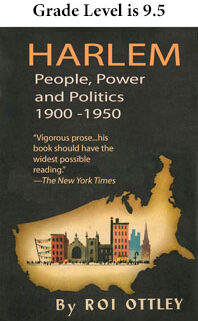
Cover of Harlem, People, Power and Politics 1900-1950

Harlem: People, Power and Politics, 1900-1950 by Roi Ottley

To read this ebook using Google Play Books on your tablet or computer, or iBooks on an iPad, download this epub format.

To read on a device from Amazon, or on the Kindle app on your computer, here is the ebook in mobi format.

Directions on how to email this file to your Kindle device are here.
To add this mobi file to your Kindle for PC software to read the chapters on your computer, see these instructions .

The Kindle WhisperCast Service  allows teachers, or librarians to send a mobi file to a group of student Kindle email addresses even if the document or ebook was not purchased on Amazon. In the WhisperCast Service, the mobi files you upload such as this one, will then be found in the Documents folder. Only items purchased on Amazon, will appear in the Books folder.

Editorial reviews of the book at its original publication in 1943 with the original title of ‘New World A-Coming’ Inside Black America.

“Vigorous prose…his book should be read as widely as possible.” —The New York Times.
“A fine book, searching, temperate, and wise.” —The New Yorker.
“A truly remarkable book, rich in scholarship and human sympathy…One of the most important books of our time.” —Chicago News.
“A shrewd, lively and often surprising interpretation of the present state of mind of Negro America.” —Lewis Gannett, New York Herald Tribune.

An Excerpt from the 1943 review of the book with its original title “New World A-Coming: Inside Black America,” in the New York Times, August 10, 1943
From Books of the Times
by John Chamberlain
THIS is a war for democracy,” says the anti-Hitler white American. “Brother,” said the Negro, “I’m going to hold you to that.”
The Negro’s tone is polite. But it is firm. Both the firmness and the politeness are in Roi Ottley’s “New “World A-Coming: Inside Black America,” which started out to be a book about Harlem and ended up by becoming a book about the Negro’s position in wartime America. Mr. Ottley, who spent seven years covering Harlem as a reporter, editor and columnist for The Amsterdam Star News, knows both his home locale and the wider impli­cations of his subject. He writes a vigorous prose, mingling his­tory, humor, irony, drama and sober re­flection in a work that explains the cur­rent status and the wholly reasonable demands of the Negro as no other book does.
In 1900 Harlem was a cheerful neighborhood of broad drives, brownstone fronts and quiet, almost suburban aloofness. Its small Negro population consisted of the black aristocracy, in­cluding Bert Williams, the actor, and Harry T. Burleigh, the composer. As the little Negro com­munity expanded, racial warfare broke out, a war that the white real estate men were winning up to the time when the Pennsylvania Railroad, seeking a site for a new central terminal, paid $510,000 in cash for a Negro church in the Thirty-third Street district With this money Negroes bought thirteen large apartment houses on 135th Street near Lenox Avenue, and the modern his­tory of Harlem had begun.
Mr. Ottley traces that history in all its tumultuous ramifications. Harlem is colored. But color in Harlem is infinitely subdivided, with African, Mongolian, European, Indian and Latin-American mixtures making the place an anthropologist’s despair—or paradise. Since the purchase of the thirteen apartment houses on 135th Street black Harlem has become a by-word for overcrowding. In the Twenties Harlem had its brief springtime. “Keed” Chocolate, Tiger Flowers and Battling Siki paraded its streets; Marcus Garvey preached his back-to-Africa doctrine and sold stock in his Black Star steamship line, which ultimately failed for thousands of dollars. The Negro renaissance was under way, with Paul Robeson, Roland Hayes and Charles Gilpin becoming big-time names. But the Twenties faded swiftly into the depression years—the era of Father Divine and his comforting Heavens, and of Joe Louis who did more than anyone else to save the self-respect of a race. …
With his chapter on Joe Louis Roi Ottley moves out of Harlem into the broad currents of Negro life in America. He writes vividly of the newest Negro leaders—Adam Clayton Powell, the cru­sading preacher; A. Philip Randolph, president of the Brotherhood of Sleeping Car Porters; Mrs. Mary McLeod Bethune, president of the National Council of Negro Women; Paul Robeson and Marian Anderson, who refuse to sing for segre­gated audiences; Ted Poston, racial adviser to-Elmer Davis; Dr. Robert C. Weaver, the first Negro ever to earn a Ph. D. in economics from Harvard University, and Chrystal Bird Fauset, adviser to Dean Landis, head of the Office of Civilian Defense. Added to the names of older Negro leaders such as Walter White, these make an imposing list.
The Axis, says Mr. Ottley in his concluding chapters, can be decisively beaten only by men who are committed to an extension of democracy to the black world. For if the war turns out to be anything less than a fight to make the princi­ples of the Bill of Rights a reality in this country, the kick-back is apt to be disastrous. Mr. Ottley says the Asiatic world is watching America, quite aware of the fact that a nation which is unable to solve its color problems at home will never be able to take the lead in creating a free world every­where. Since Mr. Ottley speaks for a people that has determinedly clenched its jaws, his book should have the widest possible reading. The Negro today is on march. Mr. Ottley tells us both how and why.
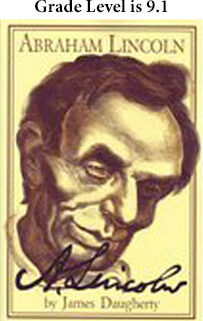
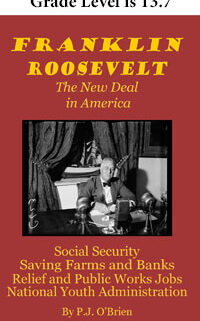
 

Image of Abraham Lincoln on Book Cover

Abraham Lincoln by James Daugherty

Download the epub format for Android tablets, Chromebooks and Apple devices:

Download the mobi format for Amazon devices:

James Henry Daugherty (1889-1974), winner of a Newbery Medal for Children’s Literature, was born in Asheville, North Carolina, but grew up in Indiana and Ohio. When he was 9, the family moved to Washington D.C., where he studied at the Corcoran School of Art, and the Philadelphia Art Academy. He then spent two years in London studying under Frank Brangwyn.

According to the New York Times, Mr. Daugherty “won distinction as a writer and illustrator of children’s books on American historical themes.”

Mr. Daugherty’s books of biography and frontier tales include “Abraham Lincoln,” “The Landing of the Pilgrims,” “West of Boston” and “Their Weight in Wildcats.”

Daugherty’s first publication was an illustration for John Flemming Wilson’s series, Tad Sheldon, Boy Scout (1913). He then worked camouflaging ships and creating four murals in Loew’s State Theatre, Cleveland, while illustrating fiction, and signed and unsigned magazine work. In 1925 he was asked to illustrate R.H. Horne’s King Penguin which he describes as the first book he ever illustrated. In 1926 S.E. White’s Daniel Boone, Wilderness Scout appeared, with Daugherty illustrations. He won the Newbery in 1940 for his self-illustrated Daniel Boone and was runner-up for two Caldecott Medals with Andy and the Lion, 1939, and Gillespie and the Guards, 1957.

Cover with photo of FDR

Franklin Roosevelt: The Early Years of the New Deal in America (Illustrated) by P. J. O’Brien

Grade Level on the Flesch-Kincaid readability scale is 13.7. Download an epub version for your Android tablet or phone:

Download a mobi file for your Kindle device: This is the story of some of the most dynamic years in the political history of the United States. Every student whose parents or grandparents have ever received Social Security, or benefited from a low-down payment FHA mortgage, or received unemployment insurance has Franklin Roosevelt to thank. After his inauguration in March 1933, Roosevelt persuaded Congress to build new programs to support the poor and the unemployed. He sought to save homes, farms and banks at risk of being lost during the Depression, and he did. What were these programs, and could any of them have worked in our century, such as during the crisis which started in 2008?

Directions on how to email this file to your device are here.
To add this mobi file to your Kindle for PC software to read the chapters on your computer, see these instructions .

The Kindle Personal Document Service allows teachers, or librarians to send a mobi file to up to 15 student Kindle email addresses at a time.

With Calibre, you and your students can read this ebook in epub format on computer screens. By changing the background color, and enlarging the font, the reading experience on a computer screen is reasonable.


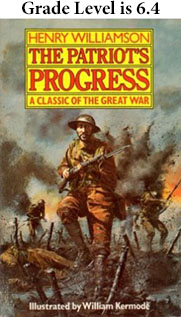
The Patriot’s Progress by Henry Williamson

The epub format below is for your Apple and Android devices including Send-to-Kindle. You can see instructions about Send to Kindle at https://www.amazon.com/gp/sendtokindle/email.

Download mobi file here.

From Goodreads:
Very unexpected memoir/novel of WW I — totally different from the many I have read. Five “phases” each are one long paragraph — not conventional in any way. “Stream of consciousness” comes to mind, but some of it is more “stream of impressions” — hard to describe, other than to say it’s all immensely powerful. Talk about “fog of war” — this is “black night of war.”

“Very unexpected” because when I ordered it I thought it was a straight memoir. Not quite!

Call it 4.5 stars. I’ll give it 5 stars for impact and 4 stars for “enjoyability,” whatever that is.

I did like it better than Henri Barbusse’s “Under Fire” semi-autobiographical novel, which is said to be the first novel to come out of WW I (published while to war was still in progress).

From the New York City Tribune (Herschel Brickell) 20 July 1930:
“Patriot’s Progress” is the attempt of a finished literary artist who has full command of his medium, and who was in the mess himself, to portray Everyman at War. [Takes reader through the tale.]
The undercurrent that lies beneath the whole book seems to mean that wiser men than John bullock have no business to let him and his kind go dumbly and uncomprehendingly into wars. . . . Mr Williamson’s battle scenes are extraordinarily good. . . .
[“The Patriot’s Progress”] will be of especial interest to those who know the other work of its author, because it shows him in a changed mood as well as a changed manner. He has suppressed that sensitivity . . . that makes him seem sentimental at times; he writes with feelings so deeply harrowed, . . . and the effect is all the stronger.

From The Nation, 17 September 1930; short and to the point:
Mr. Williamson, in his luminous descriptive prose, has written a second fine war book. It is the story of a young English private who might well have been named Everyman. For we are not shown the inner life of John Bullock in those respects wherein he differed from his fellows but we recognise him at once because he typifies his fellows. The reader follows Everysoldier from the time he joins up with high hopes and inflamed spirits on through his terrible ordeals and into the Valley of the Shadow [note the nod to Bunyan and the Bible] of agony to his emergence, crippled, forever handicapped. The story is short, graphic and haunting. It belongs among the best of the increasing number of war memorials in literature.

Oakland Tribune California, 13 July 1930:
Henry Williamson Increases His Stature With “The Private’s Progress,” Courageous and Candid Book of a War Private
. . . His use of abruptly broken sentences, his forceful punctuation, tell so much more than even his own precise and brilliant verbage could otherwise. . . .
If more such narratives of the war are to be written, let them be by those of the greatness of soul and the literary equipment of Williamson.


Book cover with airplane

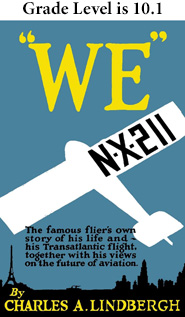
“WE” by Charles Lindbergh

The epub format below is for your Apple and Android devices including Send-to-Kindle.

As you may know, Amazon has changed to the epub format to use with the Send-to-Kindle program. A great feature of the Send-to-Kindle program is that the file will go directly to your Library folder, and not have to be searched for in ES File Explorer or another app. If you use the mobi format in Send-to-Kindle, you will now get an error message. You can see instructions about Send to Kindle at https://www.amazon.com/gp/sendtokindle/email.

If you or your students want to download directly from this web site to an Amazon device, you can use the mobi format below. When you find the mobi file in ES File Explorer, it will then open in the Kindle app on your tablet. If you download an epub file to your Amazon tablet, it will also open if you have an app such as Overdrive on your tablet. The Kindle app offers an excellent reading experience to start with. Overdrive may need some customization of font size.

Download mobi file here.

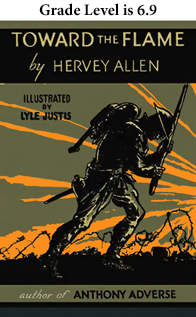
Toward the Flame: A War Diary by Hervey Allen

The epub format below is for your Apple and Android devices including Send-to-Kindle.

If you or your students want to download directly from this web site to  an Amazon device, you can use the mobi format below. When you find the mobi file  in ES File Explorer, it will then open in the Kindle app on your tablet. If you download an epub file to your Amazon tablet, it will also open if you have an app such as Overdrive on your tablet. The Kindle app offers an excellent reading experience to start with. Overdrive may need some customization of font size.

Download mobi file here.

Reviews of the Print Edition

“TOWARD THE FLAME is written in admirable and simple prose throughout … an important record.”—Saturday Review

“Filled with drama and humor. … It is unforgettable and beautiful. It has the marks of a classic.”—Bookman

“The main comfort, as seen by Mr. Allen, is that on the one hand a certain disregard for death comes from familiarity with the worst that death can do. . . . On the other hand, life, shortened in prospect, increases in intensity. . . . [One has] a quite special regard for the scholar in arms, the man who does his duty coolly and intrepidly, though his intelligence knows other allegiances.” —The New York Times

More Recent Reviews

From Goodreads 4.04 rating:

Considered by many to be the finest American combat memoir of the First World War, Hervey Allen’s Toward the Flame vividly chronicles the experiences of the Twenty-eighth Division in the summer of 1918. Made up primarily of Pennsylvania National Guardsmen, the Twenty-eighth Division saw extensive action on the Western Front. The story begins with Lieutenant Allen and his men marching inland from the French coast and ends with their participation in the disastrous battle for the village of Fismette. Allen was a talented observer, and the men with whom he served emerge as well-rounded characters against the horrific backdrop of the war.

From http://roadstothegreatwar-ww1.blogspot.com/2013/07/toward-flame-memoir-of-world-war-i-by.html

…Throughout his memoir Allen describes the attrition of war, especially the hideous affronts of war upon soldiers’ bodies and minds. Describing the effects of a shell burst he reports: Then we heard those awful agonized screams and cries for help that so often followed. It is impossible to make people at home understand what listening to them does to your brain. You never get rid of them again.
Allen continues his observations of the war as a semi-detached observer throughout his book and it is only toward the end that he records how his unit, a company down to less than half strength, finally comes in direct contact with the enemy. They are continually whittled down by German artillery at the battle of Fismette village, part of the Second Battle of the Marne, while the withdrawal order of an American officer is overruled by an obsessed French general. The narrative ends as Allen’s troops are overwhelmed by German flamethrowers, thus explaining the title of his memoir.

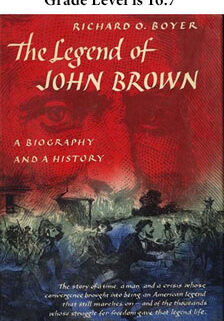
Cover of the Legend of John Brown Top Half has an image of John Brown

The Legend of John Brown: A Biography and a History by Richard Owen Boyer

Download an epub file for your Android or Apple device:

Download a mobi file for your Amazon device:

From The New York Times:
“Boyer’s book is more than a life of John Brown. It is a tapestry of the whole of American life in the generation that slid into civil war. It is a rich weave. Here is old John Quincy Adams, in his seventies, cured of his psychosomatic carbuncles by the sheer exhilaration of the struggle against the slaveowners in Congress. Here is the pro-slavery mob at Alton on the Mississippi, weeping at the sheer eloquence of the abolitionist editor, Elijah Lovejoy, but shooting him down just the same. Here is the slave rebel, Nat Turner, taunted by a Tidewater planter about his approaching execution, and answering, as John Brown himself would have answered, “Was not Christ crucified?”
Read more

Summer Reading 2026: Celebrate Our 250th Anniversary with Our Founders

Here are four eBooks about our founders written at a variety of grade levels. These free ebooks have not been banned from classrooms. Rather, they are not available because administrators in state education departments do not believe that the volume of reading matters to high school students. They demand textbooks that students find boring and don’t read. Other administrators don’t have the budgets for books, and have not yet turned to free eBooks.

Guardians of Liberty: Sam Adams and John Hancock by Olga Hall-Quest
Reading Level is 9.0

Founding Fathers by Kenneth Umbreit
Reading Level is 10.0

James Madison: Father of the Constitution by Alfred Steinberg
Reading Level is 11.7.

Patrick Henry: Firebrand of the Revolution by Nardi Campion
Reading Level is 5.6.

This link has short descriptions of each book. You can see longer descriptions of each book and other titles at History for Everyone: Build a Nation of Readers with Free Ebooks.


Summer Reading 2026: History of Science

Here are four eBooks on the History of Science written at the 4th- to 10th-grade level. You can find additional science titles at ebooksforstudents.org. These free ebooks have not been banned from classrooms. Rather, they are not available because administrators in state education departments do not believe that the volume of reading matters to high school students. They demand textbooks that students find boring and don’t read. Other administrators don’t have the budgets for books, and have not yet turned to free eBooks.

Each link provides a button to download the eBook and a short description of the content. The titles are:

Microbe Hunters by Paul de Kruif
Grade Level is 10.6. A reviewer on Goodreads wrote, “The book discusses the giants of germ theory and does so in a way that makes these scientists approachable as real men with real emotions. It must have been a groundbreaking book when it first came out in the 1920s. It is amazing how many researchers and physicians from my generation read and were impacted by this book.”

The Mosquito Man: The Story of Ronald Ross by John Rowland
Grade Level is 8.4. Here is the fascinating story of how Sir Ronald Ross brought the malaria menace under control. In 1902 Ross was awarded the Nobel Prize for Medicine; 1926 marked the opening of the Ross Institute and Hospital for Tropical Diseases. And today, in Malaya, in Africa, in India, in China, in Japan—wherever there is malaria, Sir Ronald Ross will be remembered gratefully, because he showed men how to conquer a killing disease.

Vanquishing Yellow Fever by Edward F. Dolan
Grade level is 4.5.  No sooner had the Spanish-American War ended —a war lasting less than five months—than a killer of men appeared in Cuba that was far deadlier than any man-made arms. Yellow fever, which for centuries had ravaged the island population, struck down Cubans and Americans alike. This is the story of how Walter Reed and his colleagues discovered how yellow fever was transmitted and how they suppressed it.

The Penicillin Man: The Story of Alexander Fleming by John Rowland
Grade Level is 9.3. “This book is more than the story of a great discovery. It is an inspiring account of the rewards, both in fame and personal satisfaction, that a scientific career offers.”—New York Times.
“From Scottish farm boy to Nobel Prize winner, this book traces the events that led a brilliant mind to a new concept in the treatment of disease: the body has natural defenses against disease that must be discovered and enhanced. Teenagers who have grown up in the security of antibiotics will gain a perspective on medicine’s swift progress in the few years since Fleming discovered the bacteria-killing mold “—Scholastic Teacher.


Summer Reading 2026: Reading about World War II at a 6th Grade to 8th Grade Level

Here are fifteen eBooks on World War II written at the 6th- to 8th-grade level. These free ebooks have not been banned from classrooms. Rather, they are not available because administrators in state education departments do not believe that the volume of reading matters to high school students. They demand textbooks that students find boring and don’t read. Other administrators don’t have the budgets for books, and have not yet turned to free eBooks.

Each link provides a button to download the ebook and a short description of the content. The titles are:

The Mad Dog of Europe by Albert Nesor and Herman Mankiewicz 
An American Bomber Pilot: Serenade to the Big Bird by Bert Stiles
The Fall of France: The Wounded Don’t Cry by Quentin Reynolds
The Battle of Britain: The Last Enemy by Richard Hillary
War in the Pacific: Helmet for My Pillow by Robert Leckie
Slightly Out of Focus by Robert Capa: The Early Hours of D-Day 
The British in North Africa: Patrol by Fred Majdalany
U. S. Army in Europe: Road to Huertgen by Paul Boesch
Agent in Italy by S.K.: How to Survive as a Spy
The Road to Stalingrad by Benno Zieser: World War II on the Eastern Front
An Army of Amateurs by Philippe De Vomecourt: The French Resistance to Nazi Occupation
Solidarity in World War III: Give Us This Day by Sidney Stewart
The Fall of the Philippines: Escape from Corregidor by Edgar D. Whitcomb
Last Flight from Singapore by Arthur Donahue: The Fall of Singapore
The Fall of Malaya, Burma, and the Dutch East Indies: Action in the East by O.D. Gallagher 

You can see longer descriptions of each book and other titles at History for Everyone: Build a Nation of Readers with Free Ebooks.