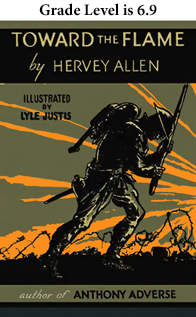
Toward the Flame: A War Diary by Hervey Allen

The epub format below is for your Apple and Android devices including Send-to-Kindle.

If you or your students want to download directly from this web site to  an Amazon device, you can use the mobi format below. When you find the mobi file  in ES File Explorer, it will then open in the Kindle app on your tablet. If you download an epub file to your Amazon tablet, it will also open if you have an app such as Overdrive on your tablet. The Kindle app offers an excellent reading experience to start with. Overdrive may need some customization of font size.

Download mobi file here.

Reviews of the Print Edition

“TOWARD THE FLAME is written in admirable and simple prose throughout … an important record.”—Saturday Review

“Filled with drama and humor. … It is unforgettable and beautiful. It has the marks of a classic.”—Bookman

“The main comfort, as seen by Mr. Allen, is that on the one hand a certain disregard for death comes from familiarity with the worst that death can do. . . . On the other hand, life, shortened in prospect, increases in intensity. . . . [One has] a quite special regard for the scholar in arms, the man who does his duty coolly and intrepidly, though his intelligence knows other allegiances.” —The New York Times

More Recent Reviews

From Goodreads 4.04 rating:

Considered by many to be the finest American combat memoir of the First World War, Hervey Allen’s Toward the Flame vividly chronicles the experiences of the Twenty-eighth Division in the summer of 1918. Made up primarily of Pennsylvania National Guardsmen, the Twenty-eighth Division saw extensive action on the Western Front. The story begins with Lieutenant Allen and his men marching inland from the French coast and ends with their participation in the disastrous battle for the village of Fismette. Allen was a talented observer, and the men with whom he served emerge as well-rounded characters against the horrific backdrop of the war.

From http://roadstothegreatwar-ww1.blogspot.com/2013/07/toward-flame-memoir-of-world-war-i-by.html

…Throughout his memoir Allen describes the attrition of war, especially the hideous affronts of war upon soldiers’ bodies and minds. Describing the effects of a shell burst he reports: Then we heard those awful agonized screams and cries for help that so often followed. It is impossible to make people at home understand what listening to them does to your brain. You never get rid of them again.
Allen continues his observations of the war as a semi-detached observer throughout his book and it is only toward the end that he records how his unit, a company down to less than half strength, finally comes in direct contact with the enemy. They are continually whittled down by German artillery at the battle of Fismette village, part of the Second Battle of the Marne, while the withdrawal order of an American officer is overruled by an obsessed French general. The narrative ends as Allen’s troops are overwhelmed by German flamethrowers, thus explaining the title of his memoir.
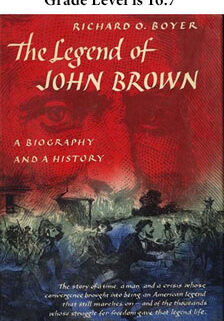
Cover of the Legend of John Brown Top Half has an image of John Brown

The Legend of John Brown: A Biography and a History by Richard Owen Boyer

Download an epub file for your Android or Apple device:

Download a mobi file for your Amazon device:

From The New York Times:
“Boyer’s book is more than a life of John Brown. It is a tapestry of the whole of American life in the generation that slid into civil war. It is a rich weave. Here is old John Quincy Adams, in his seventies, cured of his psychosomatic carbuncles by the sheer exhilaration of the struggle against the slaveowners in Congress. Here is the pro-slavery mob at Alton on the Mississippi, weeping at the sheer eloquence of the abolitionist editor, Elijah Lovejoy, but shooting him down just the same. Here is the slave rebel, Nat Turner, taunted by a Tidewater planter about his approaching execution, and answering, as John Brown himself would have answered, “Was not Christ crucified?”
Read more

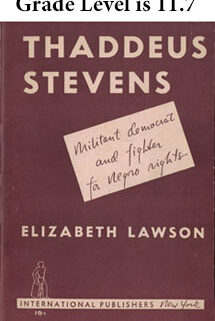
Thaddeus Stevens: Militant democrat and fighter for Negro rights

Thaddeus Stevens: Militant democrat and fighter for Negro rights

Download the epub version for your Android or Apple device:

Download the mobi version for your Amazon device:


The writer makes the political energy and moral intensity of Thaddeus Stevens clear to readers in this short, 40 page pamphlet. What was the fate of the Freedmen after the Civil War? What economic opportunities were available to them? What were Stevens’s plans for Reconstruction? Were they enacted? 

Thaddeus Stevens
 (April 4, 1792 – August 11, 1868) was a member of the United States House of Representatives from Pennsylvania. He was one of the leaders of the Radical Republican faction of the Republican Party during the 1860s. A fierce opponent of slavery and discrimination against African Americans, Stevens sought to secure their rights during Reconstruction, leading the opposition to U.S. President Andrew Johnson. As chairman of the House Ways and Means Committee during the American Civil War, he played a leading role, focusing his attention on defeating the Confederacy, financing the war with new taxes and borrowing, crushing the power of slave owners, ending slavery, and securing equal rights for the Freedmen.

As the most powerful leader in Congress of the Radical Republicans, he asked the nation what would political rights mean after the Civil War “without jobs, land, bread and shelter.”

Elective 1: Reading and Writing about World War II at a 6th Grade to 8th Grade Level

The epub format below is for your Apple and Android devices including the Send-to-Kindle feature in Amazon.

Download  the mobi file for Amazon devices except the Send to Kindle feature  here.

Enjoy descriptions and links to fourteen eBooks written at the 6th to 8th grade level. Please preview each book since the subject matter in some texts is disburbing.

Elective 2: Reading and Writing World War II at 9th-10th Grade Reading Levels

The epub format below is for your Apple and Android devices including the Send-to-Kindle feature in Amazon.

Download  the mobi file for Amazon devices except the Send to Kindle feature  here.

Enjoy descriptions and links to four eBooks written at the 9th to 10th grade level. The titles are:

Is Tomorrow Hitler’s? by H.R. Knickerbocker: The Rise of Hitler
No Woman’s World by Iris Carpenter: U.S. Army in Western Europe
Purple Heart Valley by Margaret Bourke-White: Torpedoed in the Mediterranean
Dear Fatherland, Rest Quietly by Margaret Bourke-White: A Report on the Collapse of Hitler’s ‘Thousand Years’

Elective 3: Reading and Writing Black History at 6th-8th Grade Reading Level

The epub format below is for your Apple and Android devices including the Send-to-Kindle feature in Amazon.

Download  the mobi file for Amazon devices except the Send to Kindle feature  here.

Enjoy descriptions and links to nine eBooks written at the 6th to 8th grade level. The titles are:
The Long Black Schooner by Emma Gelders Sterne: The Voyage of the Amistad
Revolts, Resistance and Emancipation by Dorothy Sterling: How Slaves and Society Resisted Slavery
The Narratives of Fugitive Slaves by Benjamin Drew: Fleeing to Safety in Canada
Three Autobiographies by Frederick Douglass: How the Abolitionist Leader Resisted Slavery
The Autobiography of an Ex-Coloured Man by James Weldon Johnson: His Travels in the North and South
Home to Harlem by Claude McKay: Life in Harlem in the 1920s
Fire in the Flint by Walter E. White: A Doctor Returns to the Jim Crow South
W. E. B. Du Bois by Emma Gelders Sterne: A Founder of the N.A.A.C.P
Mary McLeod Bethune by Emma Gelders Sterne: She Defended the Right to Vote and Built a College

Elective 4: Reading and Writing Black History at a Reading Level of 9th-12th Grade

The epub format below is for your Apple and Android devices including the Send-to-Kindle feature in Amazon.

Download  the mobi file for Amazon devices except the Send to Kindle feature  here.

Enjoy descriptions and links to nine eBooks written at the 9th to 12th grade level. The titles are:
The Black Napoleon by Percy Waxman: the Story of Toussaint L’Overture
Flight to Freedom by Henrietta Buckmaster: the Story of the Underground Railroad
Reconstruction: America After the Civil War by Henrietta Buckmaster: Freedmen and the Struggle for Political Rights
Freedom Ride by James Peck: Freedom Riders Challenge Segregation in the South
Harlem─People, Power and Politics, 1900-1950 by Roi Ottley: Profiles of Harlem’s Leaders
Thurgood Marshall from His Early Years to Brown by Hunter R. Clark: a Window into American History
Thurgood Marshall─His Triumph in Brown, His Years on the Supreme Court by Hunter R. Clark: Capital Punishment, Abortion, Affirmative Action, the Right to Counsel and Other Issues
Before the Mayflower by Lerone Bennett, Jr.: the History of the Negro in America, 1619-1962
The Lonely Warrior─The Life and Times of Robert S. Abbott by Roi Ottley: a Publisher Encourages Migration North

Asleep at the Wheel: The New York Times and Classroom Libraries

When will the New York Times begin to care about what is happening in American classrooms?

For example, parents might find it useful to know if classrooms have an adequate number of books. At one point, the New York Times discovered that classroom libraries mattered. Classroom libraries influenced students’ ability to read, but there has been no follow-up to this story for years.

Here is the story from the reporter who found the gold. He learned what was needed to improve reading achievement in a school district.

“District 19 in East New York, Brooklyn, is one impoverished district with a history of low reading scores where book expenditures may have started to make a difference. Over the last three years, the district has spent an average of $111 a student per year on textbooks and library books, the city’s highest rate, and 50 percent more than the citywide average of $74 per student.

“Joan E. Mahon-Powell, the acting superintendent of District 19, said much of the spending had gone to stocking classroom libraries, collections of 200 to 300 books in each classroom that are available to students to supplement their lessons. Getting books into children’s hands ─ a continuing problem in many districts ─ has made a big difference in how the students react to reading exercises, she said.

”When children can talk to you about reading and writing, you know you’re moving in the right direction,” Ms. Mahon-Powell said. She acknowledged, however, that the district, which still ranks near the bottom in reading scores, had far to go. ”Are our scores zooming through the roof?” she said. ”No, they are not. But we do know that they will.

Mr. Kreinik of District 28 in Queens says he, too, has emphasized spending on books and classroom libraries as well as software and other classroom supplies that do not show up on the book budget line. That money, he said, has definitely helped to improve the district’s test scores.”[i]

So, if classroom libraries and spending on books matter, certainly the New York Times would provide its readers with regular follow-ups on this information. Sadly, there have been no regular follow-ups. The Times has published two stories about ‘classroom libraries’ in New York City public schools. Both were in 2001.

The coverage or the lack of coverage by the Times matters. It needs to give space to its education writers to investigate what is happening in city classrooms. It needs to start shining its light on classrooms where students are reading and where they do not have reading materials. What influences academic achievement? the article asks. What is the proper use of resources? These questions matter.

[i] Edward Wyatt, “Success of City School Pupils Isn’t Simply a Money Matter” New York Times,

June 14, 2000, Section A, Page 1. https://www.nytimes.com/2000/06/14/nyregion/success-of-city-school-pupils-isn-t-simply-a-money-matter.html


Why Reading Volume Matters: Read Anne E. Cunningham and Keith E. Stanovich

See an excellent article titled “What Reading Does for the Mind” that could be used in professional development, or to help convince a school board that the volume of reading  should matter in secondary schools.

Online at

https://scholastic.vo.llnwd.net/o16/teacherdashboard/live/c13_s2_t1_pa3.pdf or https://www.aft.org/ae/springsummer1998/cunningham_stanovich or https://ebooksforstudents.org/whatreadingdoesforthemind/ in case one of the earlier sites disappears.


post asking for comments

Your Comments Please

We would like to know how you and your students are doing with the ebooks we have produced so that we can share this information with new readers.

Please tell us about your experiences teaching the ebook/s you have chosen for your classes. And if possible, ask your students to write with their opinions of the ebooks they are reading.

Please send your comments to support@ebookforstudents.org and we will add them to the new Reading Experiences post. And let us know if you want your name and the name of your school district included.

Thank you.