
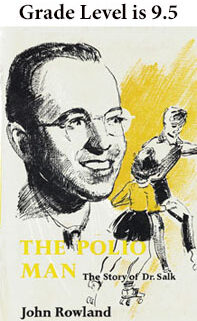
Book Cover with the Image of Dr. Salk

The Polio Man: The Story of Dr. Jonas Salk by John Rowland

Download the epub version for your Android or Apple device:

Download the mobi version for your Amazon device:

“Absorbing book . . . Young teenagers who read it will come away with a profound respect for the modest doctor.”—Kansas City Star

“Inspiring biography . . . conveys to the reader the personal rewards of a life devoted to science.”—Booklist

“Includes good background history of early-polio epidemics, theories, and work still in progress . . . approach is authoritative and objective.”—Library Journal

“He read everything he could lay his hand on,” a teacher of young Jonas recalled—and indeed Dr. Salk’s interest in great medical problems goes back to his student days in New York City. Even then he was fascinated by the mysterious virus and its role ill infantile paralysis.

On April 12, 1955, it was announced to the world that Dr. Jonas Salk had successfully tested a polio vaccine. A true man of Science, Dr. Salk had not minded the long hours of hard work in the laboratory which led to that exciting day, because he believed in the importance of his goal. By 1956 over 50 million people had been vaccinated and Dr. Salk’s fame had spread everywhere— to England, Poland, Hungary, Israel.

Dr. Salk is a great scientist but he is also a great humanitarian and fame has not lessened by his desire to serve mankind and carry on his struggle against disease. Readers who have yet to choose their life’s goal will find Dr. Salk’s story a challenge and an inspiration.

Summer Reading 2026: History of Science

Here are four eBooks on the History of Science written at the 4th- to 10th-grade level. You can find additional science titles at ebooksforstudents.org. These free ebooks have not been banned from classrooms. Rather, they are not available because administrators in state education departments do not believe that the volume of reading matters to high school students. They demand textbooks that students find boring and don’t read. Other administrators don’t have the budgets for books, and have not yet turned to free eBooks.

Each link provides a button to download the eBook and a short description of the content. The titles are:

Microbe Hunters by Paul de Kruif
Grade Level is 10.6. A reviewer on Goodreads wrote, “The book discusses the giants of germ theory and does so in a way that makes these scientists approachable as real men with real emotions. It must have been a groundbreaking book when it first came out in the 1920s. It is amazing how many researchers and physicians from my generation read and were impacted by this book.”

The Mosquito Man: The Story of Ronald Ross by John Rowland
Grade Level is 8.4. Here is the fascinating story of how Sir Ronald Ross brought the malaria menace under control. In 1902 Ross was awarded the Nobel Prize for Medicine; 1926 marked the opening of the Ross Institute and Hospital for Tropical Diseases. And today, in Malaya, in Africa, in India, in China, in Japan—wherever there is malaria, Sir Ronald Ross will be remembered gratefully, because he showed men how to conquer a killing disease.

Vanquishing Yellow Fever by Edward F. Dolan
Grade level is 4.5.  No sooner had the Spanish-American War ended —a war lasting less than five months—than a killer of men appeared in Cuba that was far deadlier than any man-made arms. Yellow fever, which for centuries had ravaged the island population, struck down Cubans and Americans alike. This is the story of how Walter Reed and his colleagues discovered how yellow fever was transmitted and how they suppressed it.

The Penicillin Man: The Story of Alexander Fleming by John Rowland
Grade Level is 9.3. “This book is more than the story of a great discovery. It is an inspiring account of the rewards, both in fame and personal satisfaction, that a scientific career offers.”—New York Times.
“From Scottish farm boy to Nobel Prize winner, this book traces the events that led a brilliant mind to a new concept in the treatment of disease: the body has natural defenses against disease that must be discovered and enhanced. Teenagers who have grown up in the security of antibiotics will gain a perspective on medicine’s swift progress in the few years since Fleming discovered the bacteria-killing mold “—Scholastic Teacher.