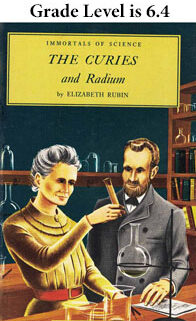
The Curies and Radium by Elizabeth Rubin

Grade Level on the Flesch-Kincaid readability scale is 6.4. Download an epub version for your Android tablet or phone:

Download a mobi file for your Kindle device: PIERRE and MARIE CURIE are perhaps the most remarkable husband-and-wife team in the history of science. Together they set out to isolate the mysterious radioactive substance in the masses of pitchblende ore available to them in the old shed that was their laboratory. It was back-breaking work, but Marie and Pierre kept at it. Finally, they obtained a product whose radiation was four hundred times greater than that of uranium! Marie called the new element Polonium, after her beloved native Poland. Later, they isolated their famous element radium — nine hundred times as active as uranium! Pierre’s brilliant career was cut short by his tragic death in 1906, but Marie went on with their courageous work alone. In 1911, she received the Nobel Prize for the discovery of radium. True, it was Marie’s long exposure to radium and X-rays that caused her death. But out of her death came life, for radium is one of modern medicine’s greatest life-savers. The basic idealism and determination of the Curies are captured for budding scientists to ponder. Scientific language is suitable for young readers.

Directions on how to email this file to your device are here.
To add this mobi file to your Kindle for PC software to read the chapters on your computer, see these instructions .

The Kindle Personal Document Service allows teachers, or librarians to send a mobi file to up to 15 student Kindle email addresses at a time.

With Calibre, you and your students can read this ebook in epub format on computer screens. By changing the background color, and enlarging the font, the reading experience on a computer screen is reasonable.


Pioneers of Freedom by McAlister Coleman

Download an epub file for your Android or Apple tablet, or Chromebook.

Download a Kindle file for your Amazon device.

In simple, vigorous fashion, and in a style so clear that it can be read with pleasure by high school students, Mr. Coleman tells the stories of nine men and one woman whom he has chosen as the outstanding leaders of the forces of democracy in America. Some of them are known to every schoolboy, a few of them have almost been forgotten, but all of them again glow with life in these vivid pages.

Here they are — Jefferson, Paine, Wendell Phillips, ‘Gene Debs and the rest—leaders of American democracy. Unforgettable portraits of great men who have pointed the way to a new America.

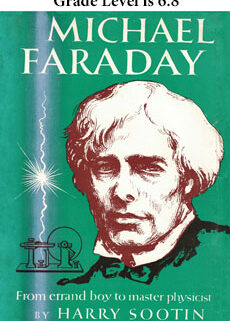
Cover with Image of Michael Faraday

Michael Faraday: From Errand Boy to Master Physicist by Harry Sootin

To read this ebook on a computer or tablet using Google Play Books, or iBooks on an iPad, download this epub format.

To read on a device from Amazon, here is the ebook in mobi format.

Directions on how to email this file to your Kindle device are here.
To add this mobi file to your Kindle for PC software to read the chapters on your computer, see these instructions .

The life story of one of the leading scientists of the last century whose experiments led to the development of the dynamo, the electric motor, and to an industrial revolution.

Michael Faraday, son of a blacksmith, was appren­ticed at fourteen to a bookbinder in whose shop he gained most of his education and acquired an interest in science—from the Encyclopedia Britannica. That interest changed and dominated his entire life, and led from errand boy to Fellow of the Royal Society.

Faraday attracted the attention of Sir Humphry Davy, a Professor of Chemistry at the Royal Institu­tion, who hired the boy as a laboratory assistant. Fara­day worked with the professor on chemical research for a number of years. He discovered benzene, butylene and the acids of naphthalene, but he never lost interest in electricity and conducted thousands of ex­periments in an effort to turn electrical energy into mechanical motion. Fie invented the first primitive dynamo and equally primitive motor, and made the first generator.

For forty years Faraday lived and worked in his rooms and laboratory at the Royal Institution. When Queen Victoria learned that he and his wife were finding it difficult to climb the stairs to their attic rooms, she presented him with one of the houses in Hampton Green Court.

Faraday was a simple man, proud and sensitive. He loved his work and refused many commercial offers that would have made him a fortune. He also refused a knighthood from a grateful country to whom he brought honor and glory as its leading scientist. Fie did. through the help and urging of his friends, accept a Fellowship in the Royal Society, and he finally ac­cepted a pension, though this precipitated the kind of publicity he had sought so hard to avoid all his life.

Today his laws of electrolysis are part of every mod­ern textbook in chemistry and physics, and the unit of electric capacity, the Farad, was named for him.

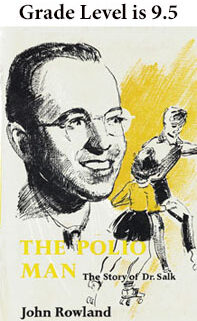
Book Cover with the Image of Dr. Salk

The Polio Man: The Story of Dr. Jonas Salk by John Rowland

Download the epub version for your Android or Apple device:

Download the mobi version for your Amazon device:

“Absorbing book . . . Young teenagers who read it will come away with a profound respect for the modest doctor.”—Kansas City Star

“Inspiring biography . . . conveys to the reader the personal rewards of a life devoted to science.”—Booklist

“Includes good background history of early-polio epidemics, theories, and work still in progress . . . approach is authoritative and objective.”—Library Journal

“He read everything he could lay his hand on,” a teacher of young Jonas recalled—and indeed Dr. Salk’s interest in great medical problems goes back to his student days in New York City. Even then he was fascinated by the mysterious virus and its role ill infantile paralysis.

On April 12, 1955, it was announced to the world that Dr. Jonas Salk had successfully tested a polio vaccine. A true man of Science, Dr. Salk had not minded the long hours of hard work in the laboratory which led to that exciting day, because he believed in the importance of his goal. By 1956 over 50 million people had been vaccinated and Dr. Salk’s fame had spread everywhere— to England, Poland, Hungary, Israel.

Dr. Salk is a great scientist but he is also a great humanitarian and fame has not lessened by his desire to serve mankind and carry on his struggle against disease. Readers who have yet to choose their life’s goal will find Dr. Salk’s story a challenge and an inspiration.

Agent in Italy: A Memoir of a Spy in World War II with a Study Guide

I couldn’t hear a sound, either from the corridor and offices beyond the door or from the sleeping city of Milan outside. All the rest of the world could have died.

It was stifling. Italian police stations are badly ventilated. My throat was very dry and I kept coughing. I smoked another cigarette but that made it worse. The smoke hung in the dead air.

I tried the door again. My wet palm slipped on the unclean handle. The door was still locked, of course.

I didn’t know exactly what time it was because they’d taken my watch away from me. I guessed about three in the morning. I was going to be shot at six.

Thus begins this amazing; book—both a thrilling story of personal danger in Italy’s underground movement, and a fully detailed, authentic report on the crumbling of Italian Fascist morale under the terror of German occupancy.

The gripping adventures experienced by S. K. during his undercover work in Italy give us a picture of methods which more than match all we have heard of German and Russian espionage work. Yet they are absolutely bona fide—the author’s credentials have been carefully checked. He remains anonymous for the protection of those colleagues still carrying on the Democratic revolution.

Working with groups of fearless Italian patriots, it was S. K. who first revealed to the outside world through confidential information on Germany’s flame-throwing tanks, the intention of Mussolini to move against Greece, the use of American dollars for the purchase of oil in French African ports by submarine captions, the shipping of Messerschimitts to Central America, the existence of camouflaged airports in Nicaragua and Bolivia, the sending of Stukas to Japan, and the building of new Condors in Holland.

In addition to these sensational disclosures, agent in Italy now reveals fully detailed story of the German occupation of Italy, giving facts and figures, including an estimate of 400,000 Germans now keeping the junior Axis partner under shaky control.

Filled with tense and breathless incident, this book, the first to disclose the bitter ordeal of Italy, bring the excitement of the mystery novel to one of the most important factual documents of our day.

To read this ebook as a pdf, see the link below.
Agent In Italy

To read this ebook using Readium on a computer, or for Google Play Books on your tablet, or iBooks on an iPad, download this epub format.

To read on a device from Amazon, here is the ebook in mobi format.

Directions on how to email this file to your device are here.
To add this mobi file to your Kindle for PC software to read the chapters on your computer, see instructions at http://tinyurl.com/y8gsazq.


An Army of Amateurs

Download an epub file for your Android, or Apple tablet, or the Send to Kindle feature on your Amazon device.


Download a mobi file for your Amazon device.

AN ARMY OF AMATEURS is the incredible story of the resistance of the ordinary Frenchman in the street to the Nazis—secretly sapping the strength of the invading armies until the final Allied victory. Here is a picture of a group of dedicated but inexperienced citizens who risked their lives and displayed enormous courage—winning despite the many blunders that amateurs were bound to make.

Philippe De Vomécourt, who with his two brothers, and the aid of Great Britain, helped to organize the resistance, began his operations by obtaining a job with the Nazis as an inspector of railroad trucks-enabling him to see that these trucks failed to get to the proper destination, to plan “escape routes” and assist in smuggling Jews to safety.

It was not long, however, before the Nazis began to suspect Philippe of being a traitor and eventually the luck of the de Vomécourt brothers ran out. One of them—who saw to it that every single torpedo ship leaving Germany was blown up—paid for his work by death in a concentration camp. Philippe was sentenced to hard labor but soon showed his unfailing ingenuity and daring by managing to escape—taking with him fifty-three other prisoners. Departing for England with a small group, he returned to France before D-Day to supervise the cloak-and-dagger activities of his own group, Special Operations Executive, enlisting anyone who was willing to help them harass the Germans.

AN ARMY OF AMATEURS is an important book, packed with heroism, hair raising escapes, and some sharp criticism of France’s allies.

Philippe De Vomécourt was born in France in 1902 and educated in England. As a young man, he joined the Flying Corps (British) in World War I, later studying agriculture and managing a farm in Africa. After marrying, he lived in the New Herbrides and then Australia before settling in France.

Scene of crowd marching and title of Runaway Russia

Runaway Russia: An American Woman Reports on the Russian Revolution

A “Gripping Account” —The Wall Street Journal

Florence Harper was the first American female journalist in Petrograd. Sure that trouble was coming, she waited “as I would for a circus parade.” From the women’s bread protests of the heady first days when the mob seemed “good-natured” to the later horror of the “Marseillaise”-singing crowds being mowed down by machine guns, she remained undaunted, repeatedly returning to the streets despite the dangers she courted daily. She searched the morgues so that she could do a story on the victims. ‘‘I did not wait to count the coffins. It was too harrowing,” she reports. She did watch the hated police being thrown off roofs and also ran the gantlet of the mutinous Kronstadt sailors, who she recalls “all looked like cutthroats.” Allied officers at her hotel smashed the contents of its cellars till they were “literally knee deep in everything from champagne to vodka” to prevent the mob from getting at them. The stoicism and sympathy with which she endured it all shine forth from this gripping account.
Helen Rappaport, The Wall Street Journal, January 28, 2017

Download a free copy for individual use or to distribute to your students.

Download this epub format to read this ebook on an Android tablet or phone or on an iPad. You can also use this epub for the Send to Kindle feature for an Amazon device.


To read on a device from Amazon, or with the Kindle app, here is the ebook in mobi format.

Directions on how to email this file to your device are here.
To add this mobi file to your Kindle for PC software to read the chapters on your computer using the Kindle app, see instructions at http://tinyurl.com/y8gsazq.

The Kindle Personal Document Service allows teachers, or librarians to send a mobi file to up to 15 student Kindle email addresses at a time.

Photo of WEB DuBois

W.E.B. Du Bois: His Was the Voice by Emma Gelders Sterne (For Young Adults)

Download in the epub format:


Download for Kindle Fire tablets and Amazon ereaders:

Teacher, social scientist, historian, poet, prophet—his was the voice that demanded equality, respect and dignity for the black man in a society that denied his humanity.

The memory of Dr. W. E. B. Du Bois is as important to the past and future of this country as any revolutionary figure before or since. Yet for years he was unknown to white America and, as a victim of the McCarthy witch hunts of the fifties, rejected by his countrymen. In this dramatic, candid biography, Emma Gelders Sterne presents W. E. B. Du Bois to a new generation that is entitled to the truth about the black man who cried “Freedom Now!” and “Black Power” when no one was willing to listen.

Drawing from the private papers of Du Bois himself, his publications, and the confidences of those who knew and worked with him, Mrs. Sterne has written an unconventional story that reads like fiction but tells the little-known facts of a fascinating life. Thanks to the support of Dr. Herbert Aptheker, Du Bois’ close friend and literary executor, Mrs. Sterne was allowed to examine unpublished materials by and about Du Bois.

William Edward Burghardt Du Bois was born in Massachusetts in 1868, three years after the emancipation of the slaves. His entire life was devoted to freeing those former slaves and their offspring from the burden of second-class citizenship. A brilliant scholar and orator who was graduated with honors from Fisk, Harvard, and the University of Berlin, Du Bois was a pioneer social scientist, champion of the emerging African nations, and a founder and controversial member of the NAACP.

He wrote nineteen books, hundreds of articles and poems, and created and edited two literary magazines. But most remarkable of all was W. E. B. Du Bois the man: a uniquely American patriot and prophet who, denied the right to return to his homeland, died in exile in Ghana in 1963—still a revolutionary at the great age of ninety-five.

A testimonial from a librarian:

“To the youth of today (and those of age who engage in creative thinking) from a librarian who believes in the power of the ‘word . . .’ ”

“I urge you to read this book. It will make you think. William Du Bois searched all of his life for directions that black and other Americans should take. I do not agree with some of the directions he has suggested and you may or may not! But he has anticipated this reaction and left an answer: ‘What I have done well will live long and justify my life. What I have done ill or never finished can now be handed down to others.’

“He was a man who was jailed by his government and refused entrance to the land of his birth. He was ignored by the people he sought to help and yet he left another message especially for you: ‘One thing I charge you. As you live, believe in life. Always human beings will progress to greater, broader, and fuller lives….’ ”

Harriett B. Brown
Supervisor of Libraries
Board of Education, New York City

The Author:
EMMA GELDERS STERNE, a former teacher and editor, has written more than twenty books in the past forty years, including Mary McLeod Bethune; Benito Juarez, Builder of a Nation; I Have a Dream; and They Took Their Stand. The recipient of many awards over the years, she was honored by the Women’s International League for Peace and Freedom, which established a children’s fund in her name.

Book Cover showing a valley

They Called it “Purple Heart Valley”-A Combat Chronicle of the War in Italy by Margaret Bourke-White


Download in epub format for your Apple or Android device or the Send to Kindle feature on Amazon devices:

Download in mobi format for your Amazon ereader or Fire tablet:

An excerpt from The New York Times review by Foster Hailey, November 26, 1944:

“Reading Miss White’s remarkable book and looking at her even more remarkable photographs, many of them taken under fire, you know that all the American men and boys, in Italy, in France, in India, China, Burma and the many Pacific islands, have what it takes to defeat their country’s enemies. That’s why they’re winning the war.

“Margaret Bourke-White’s photographic-written record of the weeks she spent slogging through the mud, riding a Jeep up and down Highway 6, climbing mountain peaks in the dark with her heavy equipment to get just the right place and the right light to shoot her pictures, photo­graphing the quick, the dead and the dying in gun emplacements. front-line foxhole, emergency dressing station and rear-base hospital, is one of the best and most remarkable books to come out of the war. The author prefers to be known perhaps as a photographer; but this book qualifies her as a first-rate reporter, in command of a lean, hard prose that is the only true medium of description for the ordered insanity of war…

“…Although the most exciting photographs and the best reading are of battle. Miss Bourke-White gives the whole picture. She tells of the misery of the Italian civilians behind the lines; the black market through which some Italians fleeced other Italians; the bungling of the American Military Government, which (by a confession to her, she said, of one of its high officials) was more interested in how the United States would react to what it was doing than of getting a disagreeable job done quietly and efficiently.”


From Foreign Affairs: Reviewed By Robert Gale Woolbert July 1945

In this intimate, first-hand description of the Cassino campaign in Italy the author has accompanied her usual superb photography with exciting text.